A multi-stop load looks simple until the route changes. One customer adds a pickup, one receiver moves an appointment, and the carrier asks for revised compensation. The brokerage now has to keep the stop sequence, instructions, customer charges, carrier costs, approvals, documents, and final billing aligned.
That makes multi-stop handling a useful TMS buying test. Do not ask only whether a system can “add stops.” Ask whether your team can prove which stop was added, what changed financially, who approved it, which document is current, and whether the customer and carrier sides reconcile.
This guide supplies a controlled three-load test. It is an operational evaluation method, not legal advice, a pricing benchmark, or a claim about any product.
The public-fact boundary
Current 49 CFR 371.3 requires a broker to keep a record of each transaction. Among other items, the record must show the bill of lading or freight bill number, the broker’s compensation and payer, specified non-brokerage services and compensation, freight charges collected, and the date the carrier was paid. The required records must be kept for three years, and each party to a brokered transaction has a right to review the required transaction record.
That rule does not prescribe your stop-off formula, decide whether a changed route earns an extra charge, define a sufficient approval, or certify a TMS workflow. Contracts, customer instructions, carrier agreements, and qualified advisers may impose additional requirements.
For current market context, Truckstop’s vendor-authored accessorial guide separates predictable charges known during setup from event-driven charges and describes stop-off charges as applying to additional stops beyond the ordinary pickup and final delivery. Its example treats one pickup plus four deliveries as three additional stops. That is a useful test convention, not a universal tariff or mandatory rate.
BrokerWare’s July 23, 2026 release notes show why counting logic deserves a live test: its own product documentation distinguishes extra pickup, extra delivery, and extra stop charge types and excludes the initial origin and final destination in the described calculation. This is evidence about BrokerWare’s documented behavior only—not ServeOps or every TMS.
Start with a written counting rule
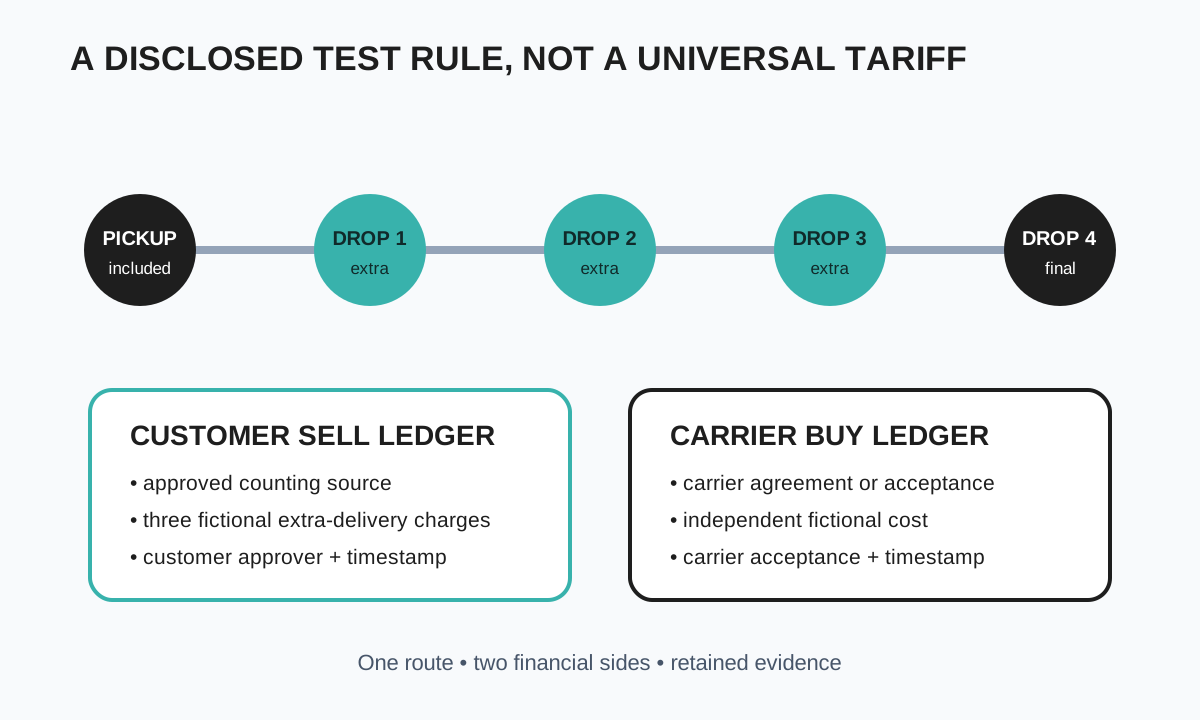
Before opening a demo, write an answer key. For this test, use this fictional rule:
- The ordinary move includes one initial pickup and one final delivery.
- Each additional pickup is counted separately.
- Each additional delivery before the final delivery is counted separately.
- Customer sell charges and carrier buy charges are independent; never assume they are equal.
- A route change requires a source, timestamp, approver, financial decision, and revised instruction set.
Use fictional facilities, parties, references, and amounts in an approved test environment. Do not enter live customer or carrier data into an unapproved trial.
Run three controlled loads
Load 1: one pickup, one delivery
Create the baseline with one origin and one final destination. Record each facility’s legal or operating name, complete address, contact, appointment window and time zone, reference, commodity or handling instruction, and stop sequence.
Under the test rule, the expected additional-stop count is zero. Save the customer sell amount, carrier buy amount, governing source, rate confirmation, and customer-facing output your process requires. The pass condition is a clean ordinary move with no invented stop charge.
Load 2: one pickup, four deliveries
Use one origin followed by four deliveries. Under the written rule, deliveries one through three are additional stops and delivery four is the final destination. The answer key therefore expects three additional deliveries.
Give each delivery a different reference and appointment window. Add a fictional customer charge and a different fictional carrier cost for the three additional deliveries. The test is not whether the amounts are “right” in the market; it is whether the system preserves the two approved financial sides and their sources.
Now inspect every relevant surface. Does the dispatch view preserve stop order? Do the correct references and instructions appear at the correct location? Does the carrier document show the agreed route and compensation? Does the customer document use the approved sell charge? Can billing identify the supporting record without guessing?
Load 3: change the route after carrier commitment
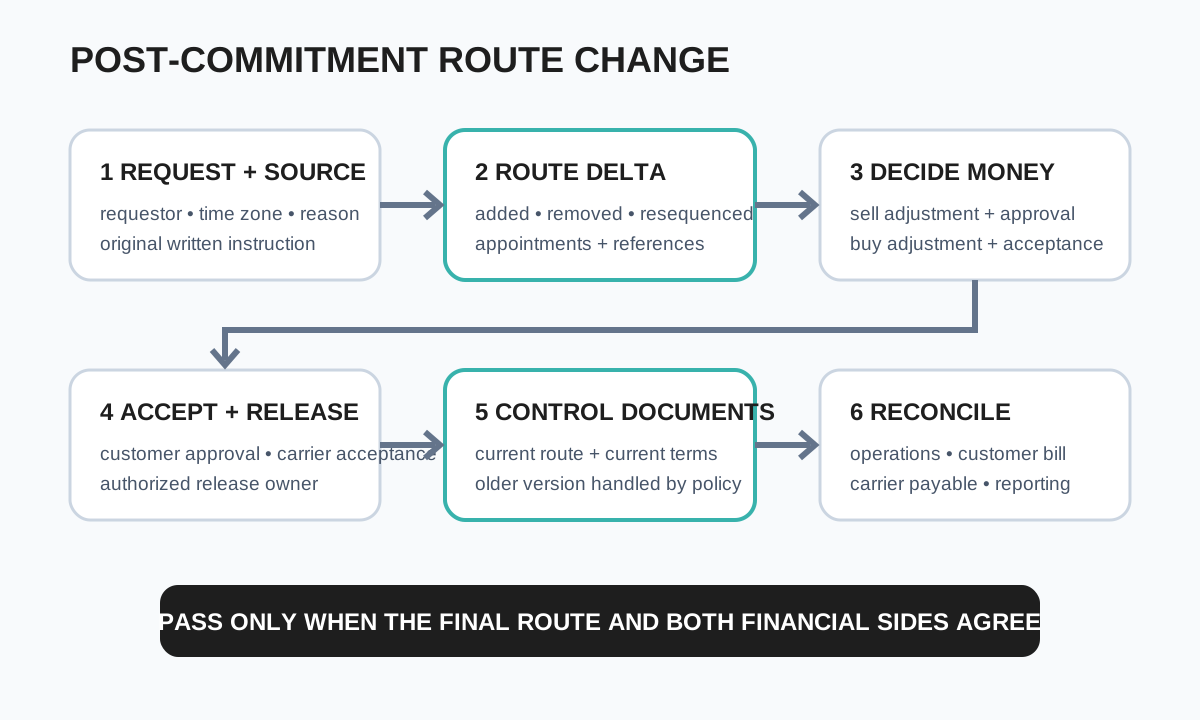
Copy the second scenario, then introduce a controlled revision: add a second pickup, remove one intermediate delivery, move another delivery earlier, and change one appointment. Do not silently overwrite the answer key.
Record the requestor, request time and time zone, original route, revised route, reason, customer approval, carrier acceptance, sell-side adjustment, buy-side adjustment, and the person who released the revision. Mark the old document as superseded according to your policy while retaining it if your legal and records process requires that history.
The final route should reconcile across the operational view, current carrier instructions, customer-facing record, customer charge, carrier cost, invoice preparation, and payable preparation. If the system cannot do part of this, document the manual control rather than giving partial automation full credit.
Score eight control points
Use pass, manual but controlled, or fail for each point:
- Stop identity: facility, address, contact, reference, instructions, and stop type stay attached to the right stop.
- Sequence and time: order, date, appointment window, and time zone remain unambiguous after resequencing.
- Freight detail: commodity, quantity, weight, handling note, or other approved detail is assigned to the intended location.
- Counting logic: the answer key and the system result agree for extra pickups, extra deliveries, and total additional stops.
- Two-sided money: customer revenue and carrier cost remain separate, traceable, and correctly totaled.
- Approval and acceptance: the route delta, customer approval, carrier acceptance, owner, and timestamp can be retrieved.
- Document control: current documents match the final route, and older versions are not easily mistaken for current instructions.
- Financial close: final operational facts, customer billing, carrier payable, and any reporting or export your team relies on reconcile.
One attractive screen is not a pass. Retain the test input, expected result, actual output, discrepancy, owner, and resolution. A transparent manual step can be acceptable; a silent mismatch cannot.
Questions to ask during the demo
- Does the system distinguish pickup, delivery, and generic stop types?
- What exactly is included before an “extra” stop begins?
- Can customer and carrier stop charges use different rules and amounts?
- What happens when a stop is added, removed, or resequenced after dispatch?
- Which fields are versioned, and which are overwritten?
- How does the team identify the current rate confirmation or instruction set?
- Are detention, lumper, and other location-specific records tied to the correct stop?
- What fails visibly if a document, approval, reference, or charge is missing?
- Can an authorized reviewer explain the final invoice and carrier payable from the retained evidence?
Public facts versus verified ServeOps functionality
Public facts and attributed examples: the eCFR recordkeeping requirements are public law; the accessorial discussion is attributed to Truckstop; the product example is attributed to BrokerWare’s own release notes.
Verified ServeOps functionality: this package does not claim that ServeOps supports multi-stop loads, stop-level fields, automatic charges, tariffs, route optimization, approvals, version history, document generation, notifications, invoicing, payables, reports, exports, integrations, or compliance. Every product behavior above is a question to test and verify before publication or purchase.
If multi-stop work is material to your brokerage, use the checklist during the verified ServeOps offer: 60-day free trial; card collected upfront; no charge for 60 days; cancel anytime; then $49 per seat/month or $490 per seat/year. Run the three-load test, record every manual step, and treat any unverified behavior as not tested.