A load can be delivered without being ready to invoice. The difference is not a status label; it is whether the brokerage can assemble one consistent story from the agreed rate, delivery evidence, charges, approvals, customer instructions, and carrier payable.
This guide gives owners, operations managers, dispatchers, and billing teams a seven-gate checklist and a three-load test. Use it to define your own invoice-ready standard or to evaluate a freight broker TMS before purchase.
> Product boundary: This is a vendor-neutral operating and evaluation method. It does not claim that ServeOps or any other TMS generates, captures, validates, matches, stores, routes, exports, or retains any named document or financial field. Verify each requirement directly in the current product and plan.
Start with the public record rule—not an assumed invoice packet
49 CFR 371.3 says a broker must keep a record of each transaction. The required record includes the consignor; the originating motor carrier and its registration number; a bill-of-lading or freight-bill number; brokerage compensation and payer; compensation for any non-brokerage service; and freight charges collected plus the carrier-payment date. The rule requires those records to be kept for three years and gives each party to the brokered transaction a right to review the required record.
That public rule is a records baseline. It does not say that every customer accepts the same invoice format, that a particular POD image is sufficient, or that a TMS automatically creates a compliant record. Your contracts, customer instructions, factoring arrangement, accounting process, and qualified advisers may add different requirements.
A June 2026 Truckstop guide describes a typical commercial sequence: the parties agree on the carrier rate, the carrier completes the load and supplies delivery evidence, the carrier invoices the broker, and the broker invoices the shipper. Treat that as vendor-authored workflow context—not law and not proof of ServeOps functionality.
Keep three packets separate
One load may need three related but different packets:
- Transaction record: the information your brokerage preserves for the brokered transaction, including the items required by current 49 CFR 371.3.
- Carrier-payable packet: the agreed carrier terms, carrier invoice, delivery evidence, approved carrier-side accessorials, exceptions, and payment record your process requires.
- Customer-invoice packet: the customer invoice plus the exact references and supporting documents that customer requires.
Do not send an internal margin view, carrier cost, unrelated customer data, or private notes merely because those items sit on the same load. Define which packet each field and file belongs to.
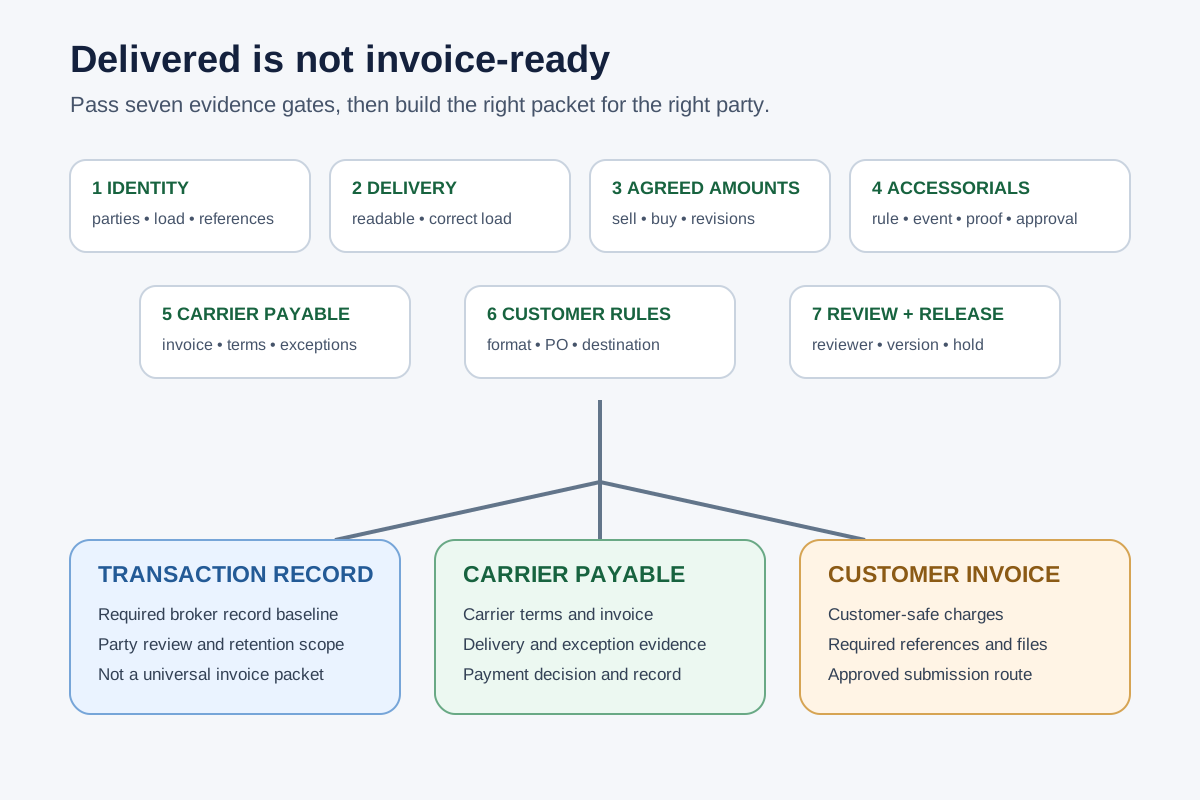
The seven-gate freight broker invoice checklist
Gate 1: Identity and references agree
Confirm the correct customer account, billing entity, carrier legal identity and registration reference, brokerage load number, customer PO or reference, origin, destination, and relevant dates. A familiar company name is not enough when one customer has several branches or billing entities.
Gate 2: Delivery evidence is readable and tied to the load
Open the actual file. Confirm it belongs to the intended load, is readable, and shows the delivery event your process relies on. Flag missing pages, an unreadable signature, an unexpected shortage or damage notation, or a document attached to the wrong shipment. Do not turn this checklist into a claim that every load legally requires the same document.
Gate 3: Agreed amounts and current charges reconcile
Compare the accepted customer terms with the customer charge, and the accepted carrier terms with the carrier cost. Check linehaul, fuel, stops, and other agreed components separately. If a value changed, preserve the earlier evidence and the authorized revision instead of silently replacing the number.
Gate 4: Every accessorial has a rule, event, evidence, and approval
For detention, layover, lumper, redelivery, truck-order-not-used, or another exception, answer four questions:
- What written term or instruction applies?
- What event triggered the charge?
- What evidence supports that event and amount?
- Who approved the customer side and carrier side?
Customer revenue and carrier cost are not automatically equal. Treat them as separate decisions and show both before recalculating expected profit.
Gate 5: The carrier payable is independently ready
Match the carrier invoice to the correct load and carrier, then compare the requested amount with the final approved carrier terms. Record unresolved deductions, advances, quick-pay choices, factoring notices, or payment instructions according to your authorized process. Invoice-ready for the customer and payable-ready for the carrier can occur at different times.
Gate 6: Customer submission instructions are satisfied
Check the invoice destination, method, file format, required reference numbers, document order, portal rules, and payment terms already approved for that customer. Record the event that starts the payment clock. A correct amount can still be rejected when the packet goes to the wrong place or omits a required reference.
Gate 7: A second person can reproduce the release decision
Before release, a reviewer should be able to see the final amounts, required documents, exception owner, approval evidence, and submission destination without reconstructing a private email chain. Stamp the review time, reviewer, packet version, and unresolved items. If a required item is missing, return the load to a named exception queue; do not call it invoice-ready.
Run a three-load document audit before trusting the workflow
Use synthetic or properly authorized data. Calculate and assemble the expected packet outside the TMS first, then compare the product output.
Load 1: Clean delivery
Use one customer reference, one carrier rate, no accessorial, and readable delivery evidence. The test passes when the team can assemble the correct three packet views and retrieve them by the intended load and party.
Load 2: Approved two-sided accessorial
Add a fictional accessorial with separate customer revenue, carrier cost, supporting evidence, and documented approvals. The test passes only when both financial sides and the final customer and carrier documents agree with the answer key.
Load 3: Deliberate blocker
Use a wrong PO, unreadable POD, mismatched carrier invoice, or unapproved charge. The desired behavior depends on your controls: a stop, a warning plus exception route, or a clearly documented manual hold may all be acceptable. Silent release is a failure.
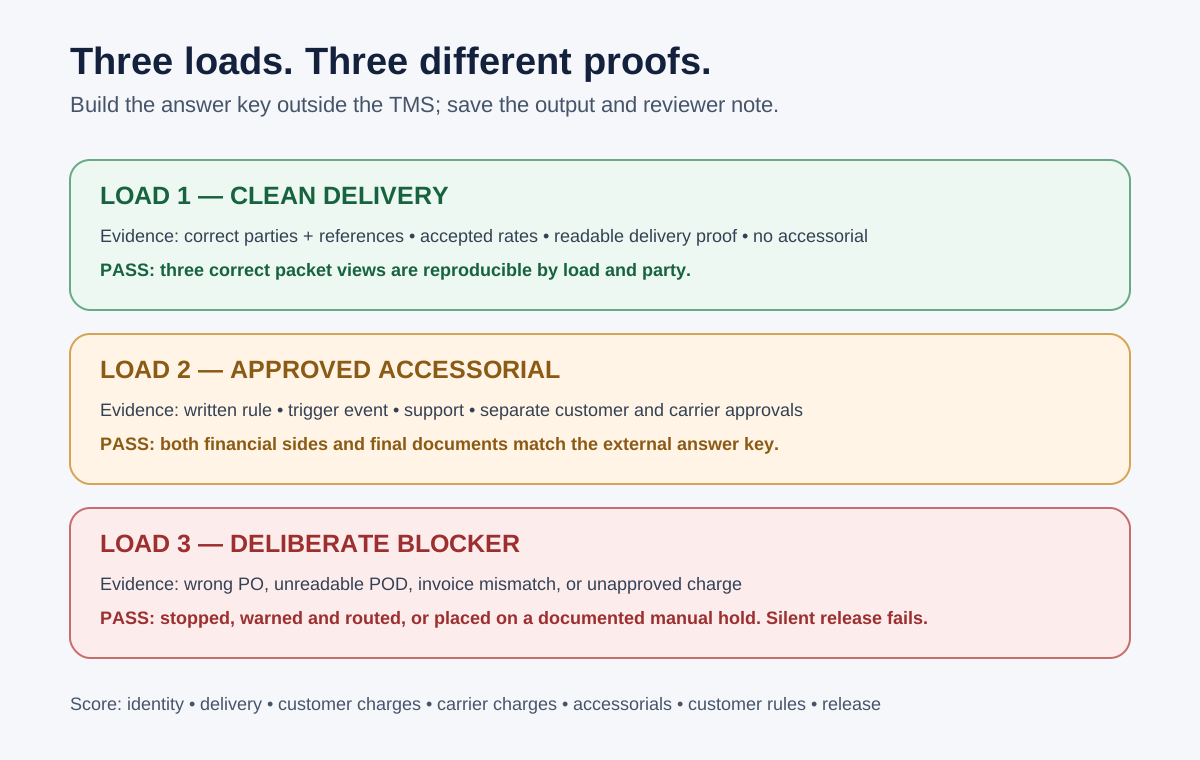
Score each load across seven columns: identity, delivery, customer charges, carrier charges, accessorial evidence, customer instructions, and reviewer release. Use pass, blocked as designed, or fail. “The screen looked right” is not evidence; retain the packet, output, and reviewer note produced by the test.
Questions to ask any TMS vendor
- Which documents can users create, attach, replace, preview, download, and export?
- Can a user distinguish the latest file from an earlier version?
- What happens when a required document or reference is missing?
- Are customer charges, carrier costs, and approvals visible as separate evidence?
- Can customer-safe output exclude carrier cost, margin, internal notes, and other customers’ data?
- Which roles can release, reverse, or edit an invoice-ready load?
- What history remains after an amount, document, customer instruction, or carrier changes?
- How are failed exports, duplicate submissions, portal rejections, credits, and rebills handled?
- What is included in the quoted plan, and what requires another system or manual step?
Write the required answer beside each question before the demo. A feature name alone is not an acceptance result.
Public facts and verified ServeOps functionality
Public fact: current 49 CFR 371.3 defines specific broker transaction-record content, a three-year retention period, and party review rights. It does not evaluate ServeOps, prescribe this seven-gate workflow, or establish a universal customer invoice packet.
Verified ServeOps functionality: no invoice, document, POD, BOL, rate-confirmation, accessorial, payable, approval, accounting, portal, export, retention, permission, history, or compliance capability is claimed in this guide. The seven gates and three-load audit are original editorial tools that readers must adapt and test.
The verified offer language is unchanged: 60-day free trial; card collected upfront; no charge for 60 days; cancel anytime; then $49 per seat/month or $490 per seat/year. Card is required upfront. There is no charge during the trial.
If your brokerage has defined its invoice-ready standard, start a 60-day ServeOps trial and run the audit with synthetic or properly authorized data. Make the buying decision from saved evidence, not an assumed workflow.
Related Broker Guides
- Set up a freight broker customer before the first load — staged; add only after the destination is approved and live.
- Test a freight broker TMS with 12 representative loads — staged; add only after the destination is approved and live.
- Verify freight broker TMS margin and markup math — staged; add only after the destination is approved and live.
Sources
- Electronic Code of Federal Regulations, 49 CFR 371.3—Records to be kept by brokers, current text accessed August 22, 2026.
- Truckstop, How the freight billing process works for freight brokers, vendor-authored article published June 11, 2026 and accessed August 22, 2026; used only for current commercial workflow context.
- ServeOps, The Human Side of Broker-Driver Relationships, accessed August 22, 2026; reviewed for overlap only, not used as product evidence.
- ServeOps, registration page, accessed August 22, 2026; complete locked offer requires final checkout verification before publication.
This guide is educational and is not legal, accounting, tax, contract, or credit advice. Confirm requirements for your contracts, customers, carriers, financing arrangements, and jurisdiction with qualified advisers.