A carrier profile can look complete and still leave a freight brokerage with an unanswered question: what was actually checked before the load moved?
That distinction matters when owners and operations managers compare transportation management systems. A carrier name, USDOT number, insurance file, phone number, and packet may be stored in one place. Storage is useful. It is not automatically identity verification, authority verification, insurance verification, ongoing monitoring, or a decision that the carrier meets your brokerage's policy.
Use this guide to separate four different jobs—record, verification, decision, and recheck—and test each one with evidence during a TMS trial. It is an evaluation method, not legal advice, a carrier-selection rule, or a guarantee against fraud.
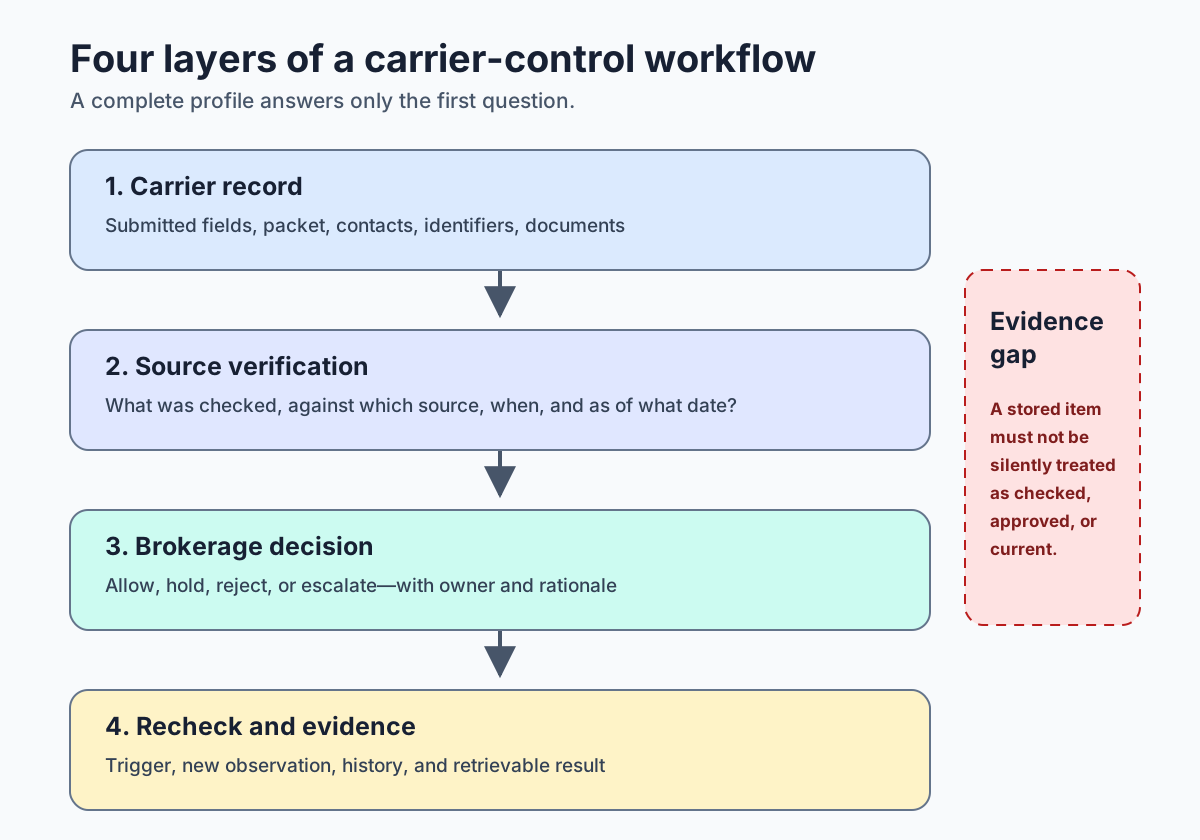
The four jobs buyers should not collapse into one
- Carrier record: fields and documents retained about a company, contact, vehicle, driver, or transaction.
- Source verification: a dated comparison between submitted information and a source your brokerage has approved for that check.
- Brokerage decision: an allow, hold, reject, or escalate outcome made under your own policy, with an owner and rationale.
- Recheck and evidence: a later review triggered by time, a changed fact, a mismatch, or a load event, with enough history to reconstruct what happened.
FMCSA's free SAFER Company Snapshot is one useful public record, but its stated scope is specific: identification, size, commodity information, safety record, safety rating if any, inspection summaries, and crash information. FMCSA's Licensing & Insurance search is a separate public destination. Neither a screenshot nor a copied field proves that someone compared the submitted carrier identity with the source at the relevant time.
FMCSA's fraud guidance makes the workflow concrete. It tells users to confirm broker and carrier phone numbers in SAFER, call the number posted there when the number provided does not match, treat document examination as critical because even insurance certificates can be fraudulent, and compare the truck and trailer that arrive with the carrier that was contracted. Those are operational checks. A carrier folder alone does not perform them.
Fourteen questions for a live TMS evaluation
Do not accept a slide or a yes/no answer. Ask the vendor to demonstrate each applicable item using synthetic carriers or data you are authorized to use.
A. Record and source
1. What is the source of each displayed fact? Can the screen distinguish carrier-submitted data, staff-entered data, imported data, and information returned by a third-party or public source?
2. What exactly was checked? “Verified” is too broad. Ask whether the check concerns identity, phone, authority, insurance evidence, equipment, driver, banking, or something else.
3. When was the source checked, and how current was its data? Look for both the check timestamp and, when available, the source's effective or as-of date. “On file” does not answer either question.
4. Can a user open the underlying evidence? The result should be traceable to a source, response, reference, or preserved artifact permitted by your policy—not just a green label.
B. Mismatch and decision
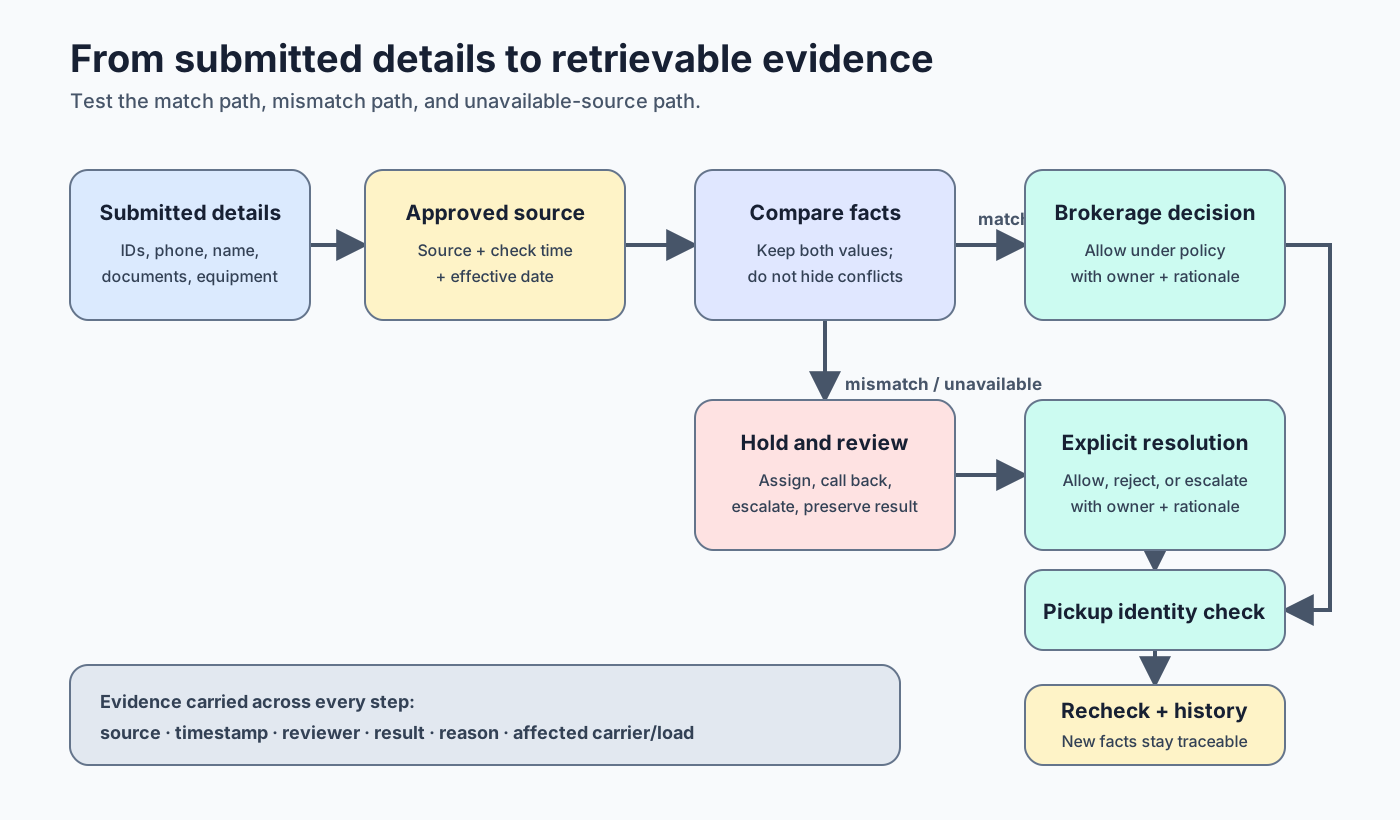
5. What happens when the phone number does not match SAFER? Test whether the workflow can hold the carrier or load, assign a callback to the SAFER-listed number, and record the result. Do not assume the TMS performs this check automatically.
6. What happens when names, USDOT/MC identifiers, addresses, or emails conflict? Use deliberate synthetic mismatches. The system should make the conflict visible instead of silently overwriting one value.
7. Can a document be marked received without being labeled verified? This is a crucial product test. Receipt, review, source confirmation, and approval should not become one ambiguous status.
8. Who owns the next action? Ask whether an exception can have an assigned reviewer, deadline, status, and escalation path.
9. Are the possible outcomes explicit? Look for your brokerage's own controlled choices such as allow, hold, reject, or escalate. Software should not invent the policy or make a legal conclusion for you.
10. Can an override preserve who, when, and why? If your policy permits overrides, test whether the original alert or mismatch remains visible beside the approver, reason, time, and affected carrier or load.
C. Pickup and continuing review
11. Can dispatch preserve a pickup identity check? FMCSA encourages confirming that the truck and trailer arriving to load match the contracted carrier and recording identifying information. Test where an authorized user would retain the comparison, any discrepancy, and the resulting escalation.
12. What triggers a recheck? Ask about time-based review, document expiration, changed carrier information, a new load, a reported mismatch, and manual recheck. Then verify which triggers actually exist.
13. What happens when a source is unavailable or changes? The workflow should not quietly convert “not checked” into “passed.” Test outage, stale-data, removed-alert, and provider-change scenarios.
14. Can you reconstruct and export the decision later? Choose one synthetic carrier and trace the submitted values, source, timestamps, mismatch, reviewer, decision, override if any, pickup check, recheck, and retained history.
A 45-minute acceptance test
Build three synthetic cases before the demo:
- Case A — clean match: submitted identifiers and phone match the test source.
- Case B — identity mismatch: phone or company details conflict, requiring a callback and hold.
- Case C — stale or unavailable check: the source cannot return a current result.
For each case, ask an operator—not the presenter—to complete the workflow. Score every applicable question:
- 2 — demonstrated: the evidence is visible and retrievable.
- 1 — partial/manual: the workflow is possible but requires a documented manual handoff.
- 0 — absent or unclear: the vendor cannot show the result.
- N/A — intentionally outside scope: your brokerage has another approved system and a defined handoff.
Do not turn the total into a universal passing score. A missing control may be tolerable if another system owns it and the handoff is tested. A polished feature may still be unacceptable if nobody can explain its source, freshness, or failure behavior.
Public facts and ServeOps functionality are separate
The FMCSA descriptions and recommendations above are public-source facts and guidance. The four-layer model, fourteen questions, cases, and scoring method are original editorial tools for product evaluation. They are not federal requirements and do not decide whether a carrier should receive a load.
For ServeOps specifically, this package did not verify automated identity, authority, insurance, fraud, safety, or compliance checks; continuous monitoring; third-party vetting integrations; risk alerts; dispatch blocks; approval gates; immutable audit logs; or automated pickup matching. Do not infer those capabilities from a carrier profile, packet workflow, or this guide. Ask ServeOps to demonstrate any capability you require and record unsupported items as manual or out of scope.
If you want to run the test in a trial, use synthetic or properly authorized data and confirm the complete terms at checkout. 60-day free trial; card collected upfront; no charge for 60 days; cancel anytime; then $49 per seat/month or $490 per seat/year.
Start the 60-day trial and run the 14-question test.
Sources
- FMCSA: Broker and Carrier Fraud and Identity Theft
- FMCSA: Fraud Alerts
- FMCSA SAFER: Company Snapshot
- FMCSA: Licensing & Insurance Carrier Search
*Public sources reviewed August 19, 2026. Recheck current guidance and product behavior before publication or purchase.*