# Accidentally Booked Two Carriers? Run This Freight Broker TMS Containment Test
An accidental duplicate carrier booking can begin with two dispatchers working the same load, a delayed screen refresh, a copied load created as “backup,” or a rate confirmation sent before another user sees the assignment. The urgent question is not which operator to blame. It is how to make one carrier current, stop conflicting instructions, preserve what happened, and keep the canceled assignment out of ordinary payment and shipment-completion work.
Use the incident as a transportation management system test. A product should not pass because it has a “covered” label. It passes only if an authorized second operator can identify the current carrier, the released carrier, the controlling documents, the financial effect, and every remaining follow-up.
This guide is an operational evaluation method, not legal advice and not a claim that any specific TMS prevents duplicate booking.
Do not confuse an internal duplicate booking with double brokering
FMCSA’s current fraud and identity-theft page describes fraud and identity theft as unauthorized use of another carrier’s USDOT number or acting as a broker without FMCSA registration. An internal mistake in which a brokerage sends the same load to two carriers is not automatically that conduct. Do not use the label “double brokering” as a shortcut; establish the facts and involve qualified advisers when fraud, identity misuse, authority, cargo control, or payment rights may be involved.
49 CFR § 371.3 separately requires a broker to keep a record of each transaction. The listed fields include the originating motor carrier’s name, address, and registration number, specified compensation and freight-charge information, and the carrier-payment date. The rule also specifies three-year retention and party review rights. It does not prescribe a duplicate-booking warning, assignment lock, document-recall feature, or cancellation workflow.
Those are public facts. The containment steps below are an original operating test, not Federal requirements.
First response: freeze the ambiguity
When the duplicate is discovered, name one incident owner and record a UTC timestamp. Pause new carrier-facing instructions until that owner establishes the facts. Do not delete a carrier, overwrite the first assignment, backdate a note, or mark a load delivered simply to clear a dashboard.
Build a short answer key outside the tested product using synthetic or properly authorized data:
- load, customer, pickup, delivery, and customer-reference identifiers;
- Carrier A and Carrier B legal names and USDOT/MC identifiers;
- approved contacts and independent verification evidence required by your policy;
- who assigned each carrier and when;
- each promised carrier amount;
- every rate confirmation or instruction version and its send time;
- whether either carrier dispatched, arrived, loaded, or incurred a claimed cost;
- the intended current carrier, decision owner, and decision time; and
- expected carrier-payable, customer-billing, document, and follow-up states.
The answer key stops the software from grading itself. It also exposes where an email inbox, shared sheet, load board, or accounting tool remains part of the real workflow.
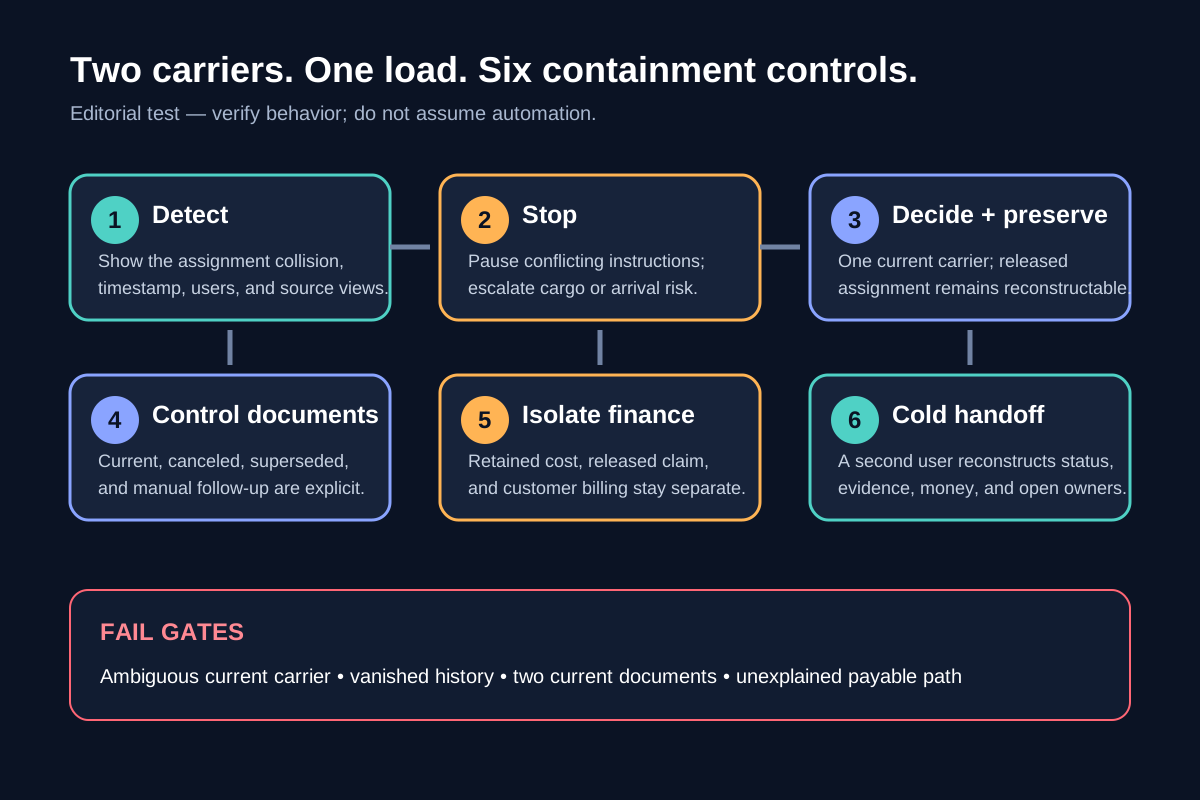
Run the six-control containment test
1. Detect the collision
Create a controlled load. Have User 1 assign Carrier A while User 2, using a separate authorized account, attempts to assign Carrier B from an older view or duplicate work item. Never share credentials, and never send test documents to real recipients.
Record what actually happens: hard block, warning, silent overwrite, second assignment, stale display, or manual-only control. A warning is useful only if the user can understand the conflict and recover without guessing.
2. Stop conflicting movement instructions
Open the load as dispatch, supervisor, and finance users. Determine whether any screen, task, document, or message still presents both carriers as current. Follow your approved contact and escalation policy to simulate stopping the released carrier. The test must not assume that a TMS recalls an email, voids a downloaded PDF, reaches a driver, or resolves contractual obligations.
If either carrier may be at the facility or in control of freight, stop the tabletop test and follow the brokerage’s real safety, customer, insurer, security, and legal procedures.
3. Make one decision—and preserve the other assignment
Choose the retained carrier using the scenario’s written policy and answer key. Record the approver, decision time, reason, and source. Mark the other assignment with an unambiguous non-current status that does not erase its carrier identity, offered amount, document, operator, or timeline.
A deletion that produces a clean screen but destroys the sequence is a failure. So is a history entry that only an administrator can decode after coaching.
4. Control documents and communications
List every carrier-facing artifact: rate confirmation, dispatch email, portal record, pickup number, calendar entry, note, and attachment. Determine which version is current and which is canceled, superseded, or requires manual follow-up.
Open the files rather than trusting their names. `ratecon-final-2.pdf` is not a control. The carrier, amount, load reference, status, version time, and owner should be clear enough for a cold reviewer. Record anything already outside the TMS; software cannot retroactively make a downloaded document disappear.
5. Separate payable exposure from customer billing
Set the expected payable state for both carriers before checking the product. The released carrier may have no approved amount, a disputed claim, or an authorized cancellation-related payment under the parties’ facts and agreements. Do not let the test decide entitlement.
Verify that the retained carrier’s current cost is reproducible and that the released carrier does not flow into ordinary payment as though it hauled the load. Separately confirm that a carrier-side payment does not automatically become a customer charge. Any cancellation, TONU, or other charge needs its own source, evidence, approval, and accounting treatment.
6. Prove the result with a cold handoff
Give the record to an authorized user who did not run the scenario. Without coaching, that reviewer should answer:
- Which carrier is current, and who approved that decision?
- Which carrier was released, when, and why?
- What independent identity evidence was used for each carrier?
- Which document is current, and which versions are not?
- Did either carrier dispatch, arrive, load, or claim a cost?
- What are the current carrier cost and customer sell amount?
- What payable or billing exception remains unresolved?
- Who owns each open contact, document, or finance action?
Score every answer Pass, Manual, Fail, or Not tested. A manual control can be acceptable when it is written, owned, repeatable, and included in training. Ambiguous carrier status, vanished assignment history, two current documents, or an unexplained payable path is a fail.
Test five collision cases, not one perfect demo
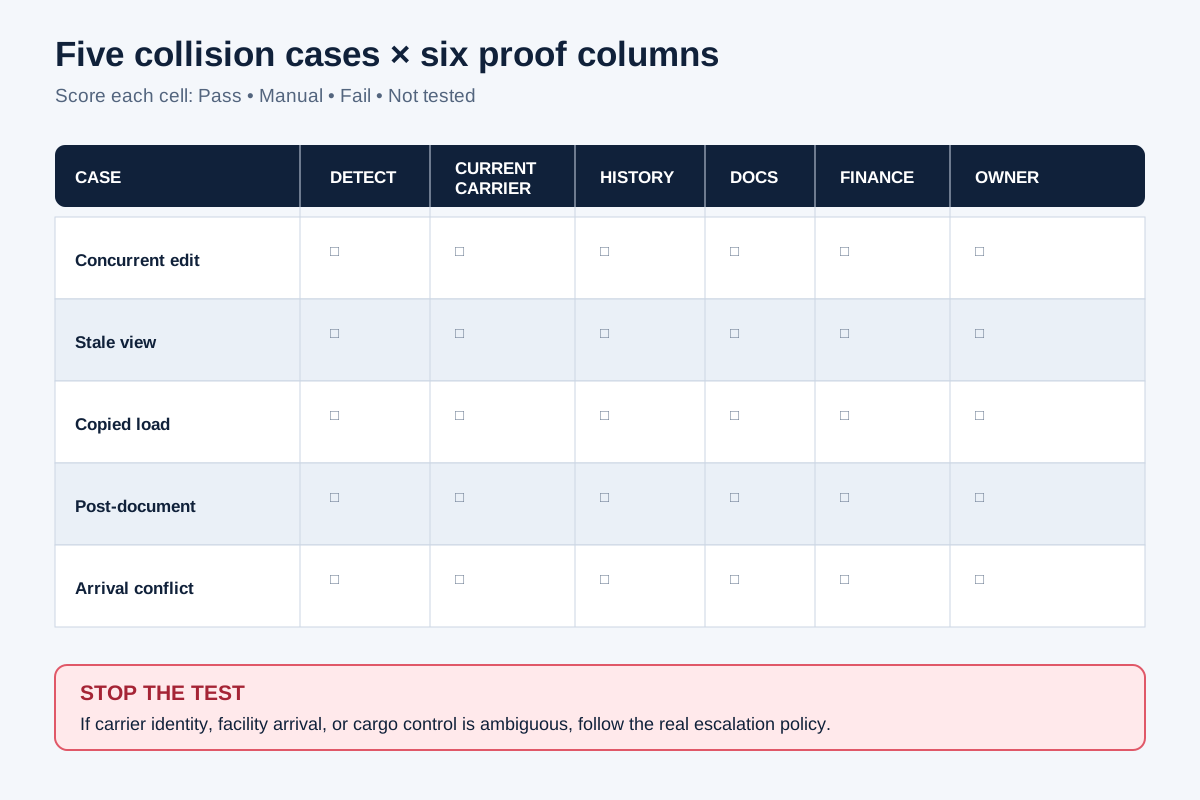
Repeat the drill with five controlled variations:
- Concurrent edit: two users assign different carriers within the same minute.
- Stale view: User 2 acts without seeing User 1’s saved assignment.
- Copied load: a duplicate load number or customer reference creates two work records.
- Post-document discovery: both carriers received a rate confirmation or equivalent instruction.
- Arrival conflict: the facility reports a carrier identity that does not match the current assignment; stop and escalate under policy.
For each case, grade detection, current assignment, preserved history, document control, payable state, and named ownership. Reject the workflow if a dangerous ambiguity survives the handoff, even when four easier cases pass.
Public facts versus verified ServeOps functionality
Public facts used here: § 371.3 describes the broker transaction record, its three-year retention period, and party review rights. FMCSA’s fraud guidance describes identity misuse and unregistered brokerage activity, recommends independently checking contact information, and advises stopping a transaction when specified red flags appear. Neither source evaluates ServeOps or defines this six-control test.
Verified ServeOps functionality: none is claimed in this guide. It does not assert that ServeOps detects duplicate loads or assignments, locks concurrent edits, preserves versions, recalls messages, voids documents, verifies carriers, calculates exposure, routes approvals, blocks payments, alerts users, or maintains an audit trail. Demonstrate each required behavior with controlled data.
The verified offer language remains unchanged: 60-day free trial; card collected upfront; no charge for 60 days; cancel anytime; then $49 per seat/month or $490 per seat/year. The public registration page currently confirms the 60-day trial, no-charge period, and cancellation language; card and price terms require a complete checkout recheck before publication.
If duplicate-booking containment is a must-have, use the ServeOps trial to run the controlled test before relying on it for live freight.
Related Broker Guides
- Carrier Fell Off a Load? Run This Freight Broker TMS Replacement Test
- Freight Broker TMS Canceled-Load Test: TONU Without a Phantom Delivery
- Freight Broker Recordkeeping Requirements: A 3-Year Transaction File Checklist
- How to Test TMS User Permissions for a Freight Brokerage
Confirm each canonical route and publication state before adding links in the CMS.
Sources
- Electronic Code of Federal Regulations, 49 CFR § 371.3 — Records to be kept by brokers, reviewed August 25, 2026.
- Federal Motor Carrier Safety Administration, Broker and Carrier Fraud and Identity Theft, reviewed August 25, 2026.
- ServeOps, registration page, reviewed August 25, 2026; used only for visible trial-language verification and the conversion destination.